In the early days, I blamed myself.
Early on, our GP wrote in one assessment, "Both these children have had a sheltered existence, due to mother trying to cope with twins and being the first pregnancy." In another assessment, the same GP wrote, "There is nothing wrong with these twins."
Those two statements left me confused and vulnerable. Amanda and Sonia were born with their disabilities, yet it was suggested that I was the one that was responsible for a long time I carried that blame and shame that it must be my fault. If it was my fault, then if I tried harder, nurtured harder, prayed harder and was a better mother, I could fix it, and the girls would "come right."
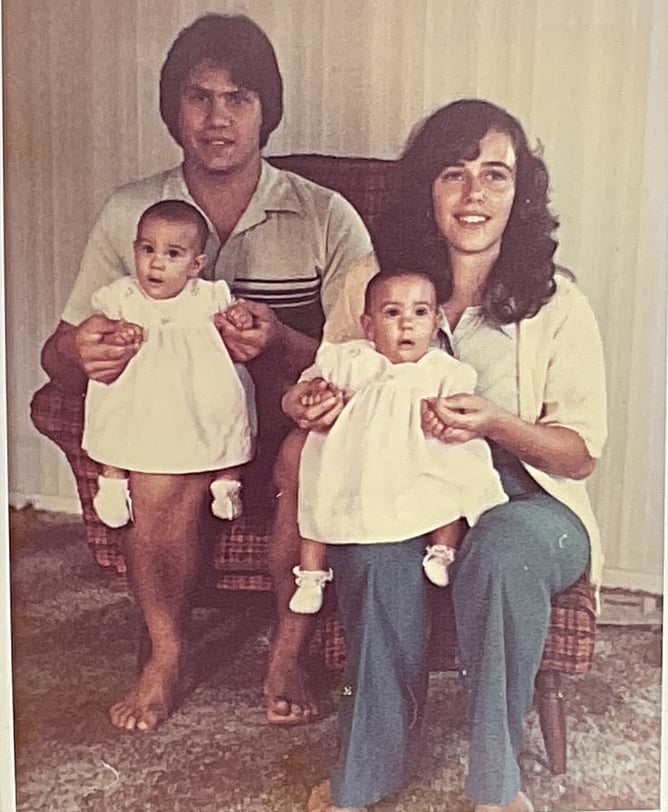
Petar and me with Amanda and Sonia, 1979.
Losing my voice
I became caught in a trap of guilt and blame, and it placed me in the land of the "Fault Zone – black-and-white thinking." If something was wrong, it must be because of something I had done, or hadn't done. I turned inward, desperately trying to hold on to hope that if I could fix myself, Amanda and Sonia's struggles would be resolved. Looking back now, I can name where I was: shut down. Confusion and uncertainty overwhelmed me. I felt stuck and I couldn't find my way out.
I know now what I needed. I needed to be heard. I needed to understand what was happening. I needed someone to sit alongside me, listen with empathy, and help me with the question I kept asking: what does the future hold for my daughters, and for us as a family? The professionals wouldn't answer it. My family loved us, but they weren't able to give me the support I needed. Somewhere along the way I lost any sense of having power in my world, and I lost my voice. I didn't feel heard.
I had no idea how to find my way back to calm and balance.
I didn't have words for any of this then. I do now, and many of them come from the No-Fault Zone®.
So what is the No-Fault Zone®?
The No-Fault Zone® is a game, and a way of having conversations, that helps us stay connected when things get hard. It's built on Nonviolent Communication (also called Compassionate Communication), developed by Dr Marshall Rosenberg, and on the person-centred approach of Dr Carl Rogers.
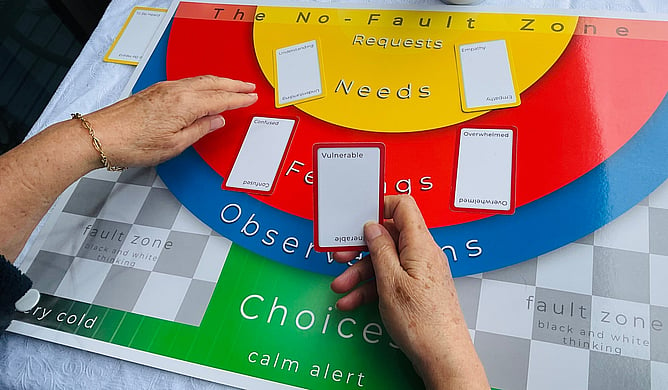
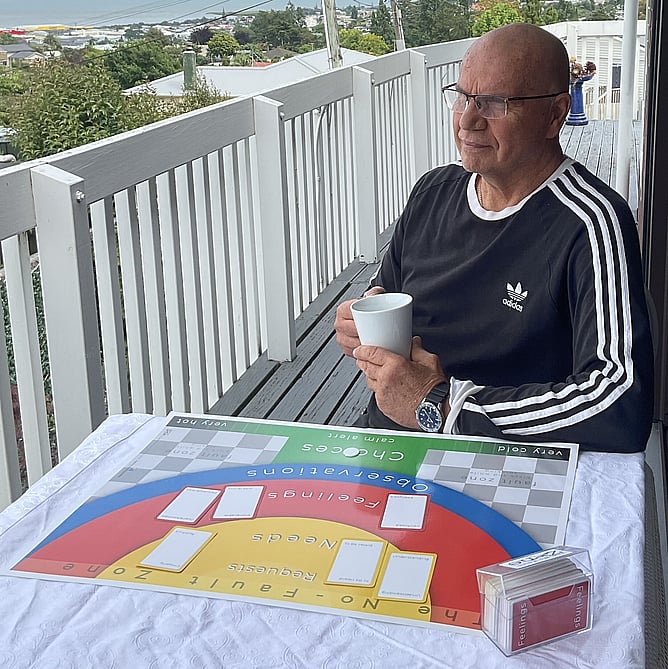
At its heart is the No-Fault Zone Mat, a visual map for a conversation:
The centre holds the four steps of Compassionate Communication: Observations (just the facts, only what a camera would record), Feelings, Needs and Requests.
The edges are the Fault Zone. This is where black-and-white thinking lives: right and wrong, good and bad, blaming, labelling, "should".
The Feeling Thermometer runs beneath, from very cold, through calm alert, to very hot. It shows where we are emotionally, moment to moment.
Feeling and Need cards give us words when we can't find them on our own.
The Fault Zone has two doors. There's a problem and it's YOUR fault, or there's a problem and it's MY fault. Either way, we end up separated, from each other or from ourselves.
Looking back through the Mat
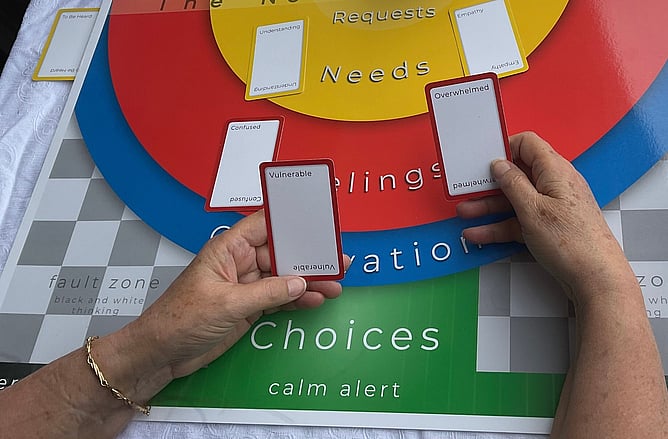
When I lay my early days over the Mat, I can see exactly where I was.
I was in the Fault Zone, through the "MY fault" door. All of my black-and-white thinking was aimed at me.
On the Feeling Thermometer, I was at the cold end: withdrawn and shut down, a long way from calm alert. That's the freeze response. When we're there, our thinking gets fuzzy and our feelings take over.
If someone had handed me the cards back then, I think I would have picked up these:
Feelings: overwhelmed, confused, vulnerable, sad, shut down, helpless
Needs: understanding, clarity, to be heard, empathy, power in my world, help and support
None of those needs were wrong. They were the needs any parent would have. They just had nowhere to go, so they turned back on me as blame.
The No-Fault Zone® would have helped me to breathe, to think, and to get my thoughts into a logical sequence. It would have given me the words to ask my questions, express myself clearly and make requests.
I also wonder how it might have changed the way others saw me. Instead of a young mother who seemed not to be coping, they might have seen a mother who knew her daughters, who was working through difficult emotions, and who was asking the right questions.
Beginning the journey, gently
If any of this sounds familiar, you don't need to learn the whole Mat today. Here are four small places to start.
Notice where you are on the Feeling Thermometer. Very cold, very hot, or somewhere near calm alert? There's no judgement here, just noticing. If you're far from calm alert, breathe slowly or take a short walk before anything else.
Name one feeling and one need. Not the whole story, just one of each: "I feel overwhelmed, because I need clarity." Naming them moves us out of the Fault Zone and back towards the centre of the Mat.
Listen for the "should". "I should have known." "I should have done more." Every "should" has a need buried inside it. Often it's care, or wanting to protect someone you love.
Make one small request of yourself. Ask: "Would I be willing to…?" Keep it simple and do-able, like resting for ten minutes, or telling one trusted person how you're really doing.
This is how moving from fault to connection begins: with yourself first, and then with the people around you.
For professionals: what I wish had been offered
What I needed most from professionals wasn't an answer they couldn't give. It was to be heard.
When a question like "what's the prognosis?" has no clear answer, there are still needs underneath it: understanding, clarity, some power in a world that has suddenly changed. We can meet those needs even when we can't answer the question. Something as simple as "It sounds like not knowing is the hardest part. You need to understand what's ahead" lets a parent know they've been heard.
It's also worth noticing how quickly we reach for reassurance. "It wasn't your fault." "It will be OK." These come from a kind place, but they can close a conversation rather than open it. I'm not sure being told what to feel would have reached me. Being heard might have.
Now, in my own practice, I try to offer what I didn't have: to stay out of the Fault Zone myself, to notice where a family is on the Feeling Thermometer, and to listen for the need behind the question.
One conversation at a time
Authentic Connection is New Zealand's only licensed No-Fault Zone® provider. Our Compassionate Communication workshops introduce the Mat, the Feeling Thermometer and the Feeling and Need cards, with real time to practise together. They're for families, for the professionals who work alongside them, and for both in the same room.
If you'd like to know more, visit authenticconnection.co.nz or email me at sandra@authenticconnection.co.nz.
Authentic connection begins with one conversation at a time. Sometimes the first of those conversations is with yourself.